
Charge transport in disordered organic matter: hopping transport

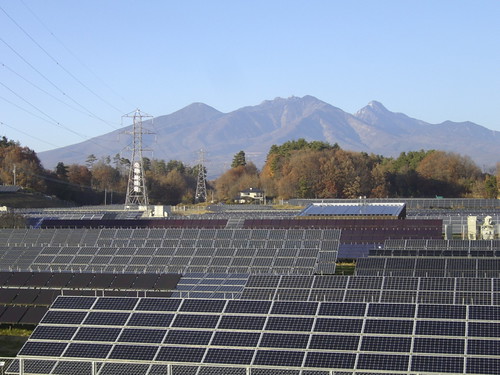
As I won a proposal today, I feel up to contributing once again some physics to this blog… I know, it has been a long long wait. So today it is time to consider some fundamentals of charge transport, as this is not only important for the extraction of charge carriers from the device PV in Japan(see earlier posts on mobility and efficiency, surface recombination velocity and photocurrent) but also the nongeminate recombination (see e.g. photocurrent part 2 and 3).
In disordered systems without long range order – such as an organic semiconductor which is processed into a thin film by sin coating – in which charge carriers are localised on different molecular sites, charge transport occurs by a hopping process. Due to the disorder, you can imagine that adjacent molecules are differently aligned and have varying distances across the device. Then, the charge carriers can only move by a combination of tunneling to cover the distance, and thermal activation to jump up in energy. In the 1950s, Rudolph A. Marcus proposed a hopping rate (jumps per second), which is suitable to describe the local charge transport. By the way, he received the 1992 Nobel prize in chemistry for his contributions to this theory of electron transfer reactions in chemical systems. Continue reading “Charge transport in disordered organic matter: hopping transport”
2012

Hi there, I am late again, but nevertheless: a happy and successful year 2012!

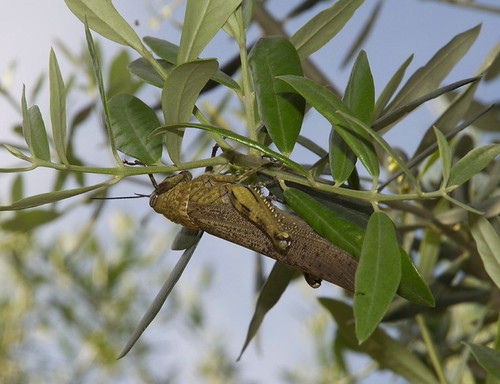
I have collected a few links which might or might not interest you. Also, I plan to start with some scientific (background) posts again. Locust in ItalyLet’s see how this works out:-)

Press release of Heliatek: Heliatek achieves new world record for organic solar cells with certified 9.8 % cell efficiency. Evaporated small molecule tandem with area above 1cm2. Very good! Also, Mitsubishi Chemical has reached 10.1% efficiency on solution processed small molecules.

Nature looks back at the science year 2011: 365 days: Images of the year.

Interesting, although not related to physics: Syllabus for David Foster Wallace’s class “English 102-Literary Analysis: Prose Fiction Fall ’94”. Clear rules, yeah! Forgot who linked to it, sorry. Continue reading “2012”

SPIE Pickings

Already 8 weeks past, recently some Videos (well, stills of the slides plus audio) of the Solar and LED Session of the SPIE Optics and Photonics 2011, San Diego went online.

Happy Family: Apes in Khandala, MaharashtraHere are two or three which might interest you (well, they got my attention;-) but there is more to be found on the above mentioned web site – although I had to modify the settings of my ad blocker to be able to watch. No, there are no ads; still…

Before you scroll down, let me mention some other “findings” of potential interest:

But now to these SPIE presentations [Update: WordPress does not accept the embedded vidos, so here just the links to the videos].

James Durrant, Imperial: Charge photogeneration and recombination in organic solar cells

Continue reading “SPIE Pickings”

Photocurrent again

I covered the photocurrent already before, for instance here. Market Place in Funchal, Madeira I pointed out that from the light intensity dependence of the short circuit current, it is impossible for many typical conditions to unambiguously determine the dominant loss mechanism or even the recombination order (1st (often called monomolecular, but not my favourite term;-) or 2nd order of decay).

If, however, you know (or guess) that the recombination order is two, you can use the above mentioned j_{sc} vs. P_L data to determine which fraction of charges is lost to bimolecular recombination, \eta_{br}. This was shown recently by [Koster 2011]. For j_{sc} \propto P_L^\alpha, they found \eta_{br} = \alpha^{-1}-1. Although I was not able to follow the exact derivation ([Update 5.4.2011] it can be derived by solving a simple differential equation, \alpha=(1-dR/dG)/(1-R/G)=(1-\eta_{br}')/(1-\eta_{br})), it seems to work. Easy method, although make sure not to have too much space charge in your device – even at the contacts, induced by low (ohmic) injection barriers (we compared it to our device simulation, and then you get significant deviations)! In my opinion, the latter point is not stressed enough in the paper, despite the nice approach. Continue reading “Photocurrent again”

This and that

Kid is growing, lack of sleep makes euphoric, but less time is less time;-)

The 2010 impact factors were just released by Thomson Reuters, Sunset at Ammerseeas most of you will know due to the mails sent by almost all publishers to tell about recent boosts of impact for their journals. A sober post was written by Jörg Heber, editor of Nature materials. A brief quote

So what use is the impact factor number? Well, being cynical one could say it is a quick measure for those that don’t read the journals but still want to know how good they are on average. The danger is of course that this is then used as a kind of metric to assess the quality of research or to decide on the career of researchers.

Continue reading “This and that”

Blue suits him better than pink

Children change the life, how very true. Not that I am less interested in Science in general, kleine HändeI do enjoy it! Nevertheless, somehow work seems less important these days – which maybe I should not admit openly ;-)

I received this statement,

Blue suits the lecturer better than pink

as one of the results of the lecture evaluation (Atom Physics for “Teachers to be”). Yes, I also received some other comments, most positive, some negative, all useful (including that one?;-)

Just to say that I am still amongst the living, here some bits and pieces I found during the last weeks, when time allowed. Continue reading “Blue suits him better than pink”

2011

A happy and successful new year to you! It is almost three years since I started this blog, this being the 69th post. A lot happened in this time, also for me: both personally (as some of the long term readers now;-) and professionally (despite still being in Würzburg;-). Golden Pavilion (Kinkaku-ji) So, let me thank you, valued reader – and comments contributor, an active participation which I highly appreciate!

Many things I want to write about I have not had time to handle in the recent months. For now, let me start with just briefly revisiting what I have written. Hints of what I will add in the coming weeks and months are to come soon (soon meaning: worst case mid February, as one proposal is submitted by then, lecture is finished and project meeting / seminar talk marathon “finished”;-).

Find the overview below. Continue reading “2011”

Two notes

A few weeks ago, Heliatek managed to take the lead for organic solar cell efficiencies, achieving 8.3% confirmed power conversion efficiency on 1.1cm2 active area with vacuum deposited small molecules. Madeira Rainbow in AutumnThe device was a tandem. Thomas Körner, VP of Sales, marketing and Business Development at Heliatek, added

The first products should be coming onto the market at the start of 2012.

Good!

Second, you may remember my post on photocurrent in organic solar cells back in July. It was inspired by a comment I wrote on a paper by Street et al, who proposed monomolecular recombination to dominate the loss of free charges in organic bulk heterojunction solar cells. My comment and Bob Street’s reply to it are now online at Phys Rev B. I’ll not comment this interesting exchange any further (unless requested by you;-), so read and think for yourself!

Add to Connotea

Hot CT complexes and Geminate Recombination

Lately, the notion that geminate recombination in organic solar cells is a major loss mechanism is more and more under fire. Foothill MountainsStreet et al present an “experimental test” for geminate recombination [Street 2010a]. They investigate P3HT:PC60BM nor PCDTBT:PC70BM bulkheterojunction solar cells with a transient current technique at 200K and 300K between -1 and 1V external voltage bias. The authors conclude that neither exhibit significant geminate recombination, while pointing out that

Since the relative importance of geminate or nongeminate recombination depends on the specific materials comprising the cell and possibly on the method of preparation, other cells may or may not have a larger geminate recombination contribution.

Continue reading “Hot CT complexes and Geminate Recombination”

Efficiencies and other notes

I mentioned the record bulkheterojunction solar cell from Solarmer recently:On top of the others 8.13%, although on a small area of 0.1cm2. The evporated small molecule solar cells had almost 6% on a ~10 times larger area. On the SPIE Optics&Photonics conference in August in San Diego I heard inofficially that Heliatek achieved more than 6%, but now on foil. Even better: more than 7% (active area efficiency; about one percent-point less for the complete area) on a module with more than 70cm2! This one is not flexible, I believe. Amazing if you consider that the evaporation is by point sources. If these modules are encapsulated, they are said to have an extrapolated lifetime exceeding 10 years.

Continue reading “Efficiencies and other notes”