
I mentioned the record bulkheterojunction solar cell from Solarmer recently: 8.13%, although on a small area of 0.1cm2. The evporated small molecule solar cells had almost 6% on a ~10 times larger area. On the SPIE Optics&Photonics conference in August in San Diego I heard inofficially that Heliatek achieved more than 6%, but now on foil. Even better: more than 7% (active area efficiency; about one percent-point less for the complete area) on a module with more than 70cm2! This one is not flexible, I believe. Amazing if you consider that the evaporation is by point sources. If these modules are encapsulated, they are said to have an extrapolated lifetime exceeding 10 years.
Tag: organic solar cells
Brief Ad: Organic Solar Cell Review Online [Update]
 If interested, find it here (Reports on Progress in Physics 73, 096401 (2010)). Included: how do bulk heterojunctions and bilayers work, how to improve the performance, how to mass print, and a brief section on the cost. I am happy it is finally “on air”:) Free from IOP for the first 30 days, if you register. Otherwise, choose the arXiv version or drop me a line. As I am on vacation, expect some delay…
[Update 30.8.2010 ] Back from vacation for already a week: was very relaxing:) In order to avoid another “ad post”, I just extend this one a bit: the progress report on charge transfer complexes (submitted to Advanced Materials already in February) is now published online. You will not find this one on arXiv, so if you cannot access it, ask me to send you the preprint. As always, I am interested in your opinion and/or criticism!
New Record for Organic Solar Cells and other stuff
Solarmer did it again: 8.13% power conversion efficiency, certified by NREL, were anounced at the currently running SPIE Optics and Photonics conference in San Diego.
I am also here, my talk will be on wednesday afternoon – but do not expect any breakthroughs in terms of performance from me:-) Maybe there will be more news here in the days to come.
 In June and July, I was visiting scientist in the group of Mike McGehee at Stanford University for five very interesting weeks. Thanks again for hosting me, and for the interesting discussions we had! I also had a brief visit to PARC, the Palo Alto Research Center, for an interesting discussion with Robert Street about the photocurrent in organic solar cells. We finally agreed to disagree on some issues, but from my point of view, that’s absolutely fine.
During my Stanford visit, there was fortunately time enough for hiking in the Foothill Mountains as well! Highly recommended. Thanks to Andreas and Verena as well as Matthias for getting me started.
Continue reading “New Record for Organic Solar Cells and other stuff”
Photocurrent in organic solar cells – Part 2 [Update]
Almost a year ago, I already discussed the photocurrent in organic bulk heterojunction solar cells. Also, recently I posted about the difficulties to determine the dominant loss mechanism from the short circuit current density dependence on the light intensity. 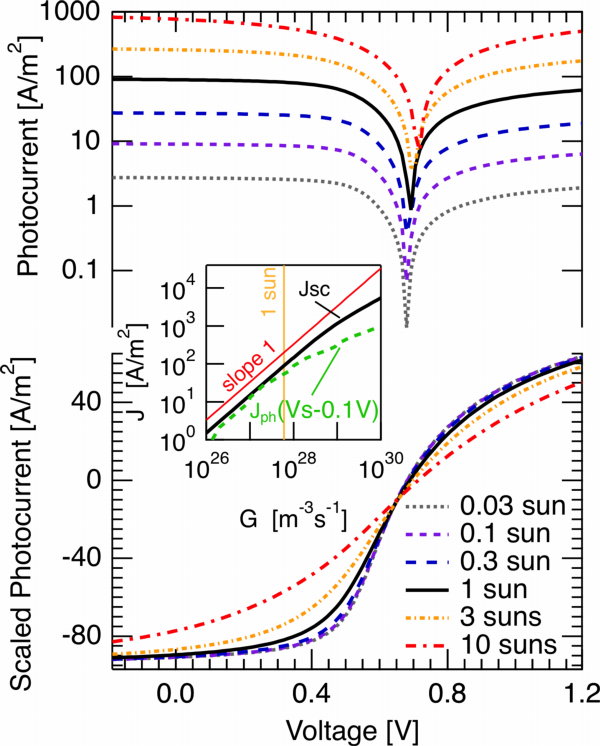 Today, I would like to extend these statements to the photocurrent in somewhat more general terms.
The figure to the right contains the simulated photocurrent for a bulk heterojunction solar cell of 100nm thickness at room temperature. Parameters were chosen according to typical experimentally determined values for P3HT:PCBM solar cells: Bimolecular Langevin recombination with a reduction factor of 0.1 and electron and hole mobility of 10-4m2/Vs were assumed (is it possible I never discussed this reduction really? Seems so, just mentioned it with references here). The top graph shows the photocurrent, in the lower graph the photocurrent was divided by the illumination density in terms of suns (thus, the current densities given on the y-axis are only correct for 1 sun). Consequently, if the photocurrent scales linearly with the light intensity, all curves should coincide. Let me remind you that this was interpreted by different groups (Street et al. among them, but not the first to follow this explanation) as a sign of first order recombination.
Continue reading “Photocurrent in organic solar cells – Part 2 [Update]”
HOPV2010 conference symposium and minor news
Three weeks ago I participated in a very nice Conference on Hybrid-Organic Photovoltaics (HOPV2010) in Assisi, Italy . Juan Bisquert, member of the Scientific Commitee, had asked me to organise a discussion panel on Carrier lifetime in bulk heterojunction solar cells. Indeed, a lively exchange of concepts and ideas between the panel – James Durrant, Germa Garcia Belmonte, Gytis Juska and myself – and the audience developed. I would like to thank the organisers, the panelists and the participants of this symposium once again: it was great! I am not sure if I will be able to summarise some of the discussion highlights here, considering that even this note took me 20 days… but I strive to improve;-)
Short note: my short review finally came online. Coauthors are Vladimir Dyakonov and Christoph Brabec. In case you have access to IEEE, find the paper here.
Type of Polaron Recombination under Short Circuit Conditions [Update]
 As promised, here a glimpse of why I believe that recombination in organic bulk heterojunction solar cells under short circuit conditions (and also at Voc) is not necessarily monomolecular.
Sometimes, the short circuit current density vs light intensity is measured, and from the linear scaling a dominant monomolecular recombination is concluded. In (partial) answer, we have performed some relevant device simulations (thanx to wapf). In short, we varied the generation of free charges over four orders of magnitude, assuming different polaron recombination mechanisms.
Continue reading “Type of Polaron Recombination under Short Circuit Conditions [Update]”
Critical View
on OPV: read the story on RenewableEnerygWorld.com:
MRS Spring Meeting 2010… already over
Last week, the MRS Spring Meeting took place in San Francisco. It was my first time there, but certainly not the last!  I enjoyed it immensely, despite my extensive last minute preparations of the talk I was invited to give… another first timer for me (on an international conference). In case you are interested, find the slides on scribd. Prof. Venkateswara Bommisetty, one of the organisers of the GG symposium told me that the slides of invited talks will also be made available (if the authors agree).
Many interesting talks, too many to go into more detail in the given time!;-) Anyway, it was nice to meet Alex (glidera) and his colleague Bertrand in person, and spend time with Andy B and Tom!
It was difficult (if not impossible) to agree with Alan Heeger and Robert Street on their propositions that monomolecular recombination is the limiting factor for organic bulk heterojunction solar cells at short circuit current under one sun illumination. Thus, despite both of them being well-known and highly respected, I allow myself to express my strong belief (supported by transient experiments and macroscopic simulations;-) that bimolecular polaron recombination is the dominant loss mechanism for free polarons, instead of monomolecular polaron recombination. Maybe more on this later.
During the conference, and featured in the talk of Karl Leo, Heliatek announced another efficiency record for small molecule solar cells, enhancing their recent achievements to now 7.7% certified efficiency for a tandem cell with 1.1cm2. Again, my congratulations, great stuff!
Continue reading “MRS Spring Meeting 2010… already over”
Be aware of ads…
I finished the Review article I was  recently talking about. If you are interested, the preprint can be accessed here
 (in a few hours, 20:00 EST according to arXiv, so be patient;-) [Update 2nd March 2010] It’s up:-)
Reviews seem to be pretty subjective, and I am sure there are many omissions, but hopefully not too many inconsistencies. If there are any particular things you do like or do not like, or which are plain wrong: I am happy about every bit of constructive criticism! I submitted the article to Rep. Prog. Phys. It will be peer-reviewed, and I am pretty sure the referees’ comments will make the current version much less final as I’d like it to be;-)
[Update 25.6.2010] The review was accepted after some minor revisions, and is scheduled for publication by Rep. Prog. Phys. in September (2010).
Towards ten percent… Solarmer hits 7.9% with plastic solar cell
Via pv-tech. Brief note on efficiency record: Solarmer has managed to get an (NREL certified) power conversion efficiency of 7.9% for an organic solar cell… sounds good, and broke the recent record (by the same company). It is important to mention, though, that the active area was very small with 0.1cm2 (aperture 0.047cm2).

