Brief Headline: Organic Bulk Heterojunction Solar Cell Efficiency

Continuing my recent history of only brief notes (sorry, busy…) here a short headline from the SPIE Optics and Photonics Conference in San Diego.

Today I heard a talk by Darin Laird, Plextronics. Green Lizards in the Loire valleyUsing an undisclosed organic donor material (well, they call their product Plexcore OS 2000 [Update below], as opposed to their P3HT OS 1000 or so) blended with the usual suspect PCBM, they managed to process an NREL certified lab scale (0.1cm2) solar cell with 5.94% power conversion efficiency! Fill factor was almost 72%, I believe, with the major improvement as compared to the reference material P3HT coming from an increased open-circuit voltage.

The corresponding solar cell module, 15×15 cm2 large, has an efficiency of 1.1% (or 2.3% active area efficiency, if you consider that only 46% of the module are active area). These numbers are brand new, but generally, uptodate solar cell efficiencies can be found in the efficiency tables (V32) by Martin Green.

So, who’s next to boost the organic solar cell efficiencies? ;-)  

P.S. As there sadly was a history of overestimated efficiencies published, followed by letters to the editors by watchful scientists and statements, a solar cell characterised by a certified institute is important to regain the trust.

P.P.S. Of course, not every university group can afford to spend 1000 bucks on a certified solar cell measurement. Still, at least some effort can be put into doing the current-voltage characterisations carefully. In January, Jan Kroon gave an interesting talk about measuring organic solar cells properly; find the video here.

Update (5.9.2008): The donor Plexcore OS 2100 available at Sigma Aldrich is not the one with which the 5.9% efficiency where achieved. The undisclosed donor material used is not yet available commercially, it seems.

Add to Connotea

iPhone Scientific Apps – and Apps for Science;-)

I have been quite quiet for a while, and now I am only briefly back with a somewhat off topic note: Science Apps for the iPhone. Macresearch already found a few of these, as described in their two blogposts. I quickly skimmed through the list of apps today, and found indeed some interesting stuff. One which will be particularly useful for me is VoiceNotes, which makes the iPhone a voice recorder (it also has some commercial but affordable competitors which I have not tested yet). Very useful to me, up to now I used to speak on my answering machine – which forwarded the messages as emails to my inbox – when some idea comes to me during driving to or from work… which happens rather frequently (both, the commuting and the voice recording;-) I am looking forward to see more applications soon.

Add to Connotea

Picture Story – How Do Organic Solar Cells Function?

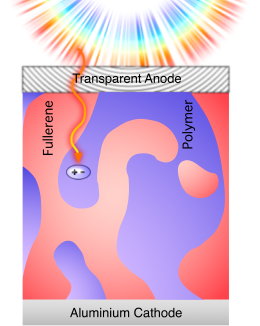
After the introductory posts about organic solar cells – split in parts zero, one and two, – I would like to present a somewhat more intuitive picture today… well, picture indeed says it all;-)

Step 1: Light Absorption => Exciton Generation

osc bhj morphology scheme - 1.jpg absorption bands polymer vs cis.jpg
  • light is absorbed in the donor material, e.g., a conjugated polymer
  • excitons are thus created, strongly bound electron-hole pairs on the polymer chain
  • very high absorption coefficient, device thickness on ~100nm scale, as compared to the inorganic polycrystalline semiconductor CuInSe2 (~1 micron) and crystalline Silicon (~100 micron)
  • but: only narrow absorption bands, as shown for two conjugated polymers P3HT and PCPDTBT in comparison to CuInSe2. This drawback could be circumvented by synthesis of novel materials, or multijunction concepts (tandem solar cells).

Continue reading “Picture Story – How Do Organic Solar Cells Function?”

Organic Photovoltaics Publications

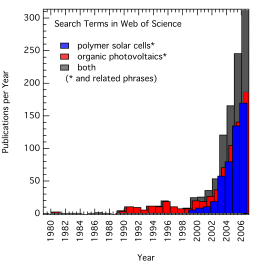
Today I came across a graph I prepared two years ago: the number of papers published per year in scientific journals within the field of organic photovoltaics. OPV in WOS (Number of Publications per Year) - 2007.pngI just updated it using Web Of Science, up to year 2007.

In case you want to reproduce the graph, I used the topic

“organic photovoltaic cell” or “organic photovoltaics” or “organic solar cell*”

for organic photovoltaics and related phrases, and

“bulk heterojunction solar cell*” or “bulk-heterojunction solar cell*” or “polymer photovoltaic” or “polymer fullerene photovoltaic” or “polymer solar cell*” or “polymer fullerene solar cell*” or “polymer-fullerene solar cell*” or “polymer-fullerene solar cell*”

Web of Science can also combine search sets in the history, so that publications matching both sets are not counted twice; the result is shown as the curve “both” in the graph. Probably, by a more appropriate choice of search terms, even some more papers can be found. For instance, I should have included small molecules.

The result is not strictly growing exponentially, but the interest still is increasing continuously. Let’s hope that the commercial interest will have similar growth rates soon;-)

Add to Connotea

A potential candidate for trimolecular recombination?

Lately, we have talked about recombination, also discussing instances where trimolecular recombination has been observed experimentally. From the different excited states observed in organic solar cells, it is not obvious which combination could be participating in a trimolecular loss process. By the way, chemists seem to know the occurance of termolecular recombination, though in different circumstances.

One candidate for an excitation involving three species it the so called trion. Turkish Coast in November SunComing from inorganic semiconductor physics, and meaning charged exciton, it has been described for organic matter already more than 20 years ago [Pope 1984] as

bound exciton plus hole (excitonic ion)

In this review (including the references therein, in particular [Agranovich 1979]), an attractive interaction between exciton and charge is described.
Continue reading “A potential candidate for trimolecular recombination?”

Polaron, Polaron Pair, Exciton, Exciplex, …

I’ve talked a lot about polaron pairs and excitons lately, and will continue to do so, Venus Transitthat this time I’ll give short explanations of what I am actually talking about. Call it definitions… ;-)

A polaron is a charge, i.e., an electron or a hole, plus a distortion of the charge’s surroundings. In a crystalline inorganic material, setting a charge onto a site does not change the surroundings, as the crystal lattice is rigid. Not so in many disordered organic materials. Putting a charge onto a certain molecular site can deform the whole molecule. Moving the charge from this to another molecule means that first the energy for the deformation – the polaron binding energy or reorganisation energy – has to be mustered. The implication is that charge transport becomes more difficult, the charge carrier mobility becomes lower, … This process is also described as self-trapping. As a side note, it is often difficult to distinguish between the influence of polaronic self-trapping and of gaussian disorder, as both have a similar impact on the charge transport properties. This similarity is also reflected in the corresponding hopping rates used to calculate charge transport: Marcus theory is a function of the reorganisation energy, where as the Miller Abrahams rate [Miller 1960] is related to the energetic disorder of the density of states. The polaronic deformation can be quantified in terms of a (lattice) polarisation, or a phonon cloud, or just as the above-mentioned polaron binding energy. Mostly, however, when hearing polaron, think charge;-) See also what wikipedia has to say about polarons.

Continue reading “Polaron, Polaron Pair, Exciton, Exciplex, …”

Recombination in low mobility semiconductors: Langevin theory

Recombination of free charge carriers in materials with a low mobility Not so early morning in north west Spainis often described with the Langevin recombination rate [Langevin 1903 (Ann. Chim. Phys. 28, 433)] (Update 3.12.2008: wrong reference previously, sorry.) Generally, if electron and holes – being potential recombination partners – wish to recombine, the effective recombination rate is proportional to

  • the “direct” recombination rate
  • finding each other

In high mobility semiconductors, the former is dominant. However, in disordered solids, and particularly disordered organic semiconductors, the low mobility limits the effective recombination rate. The process of finding each other can be described as diffusion limited, which is proportional to the charge carrier mobility when considering the Einstein relation. Continue reading “Recombination in low mobility semiconductors: Langevin theory”

For starters: Recombination

In disordered organic semiconductors, there is no band transport, as there are no delocalised, just localised charges. Consequently, there is no simple band-band recombination of free carriers, and no Shockley-Read-Hall recombination! Of course, there is still recombination going on, a lot of it;-) Church inside
Here I’ll just quote some definitions concerning different types of recombination, and get back with details later.

For a general classification we take a look at Kwan-Chi Kao’s book “Dielectric Phenomena in Solids“.
Looking for monomolecular recombination, we find

The recombination that involves one free carrier at a time, such as indirect revombination through a recombination center (e.g., an electron captures by a recombination center and then recombined with a hole, each process involving only one carrier), is generally referred to as monomolecular recombination.

In organic semiconductors, a recombination centre can for instance be a trapped hole, localised in a deep state; it can induce a monomolecular recombination with a mobile electron. Even knowing this, it still feels like bimolecular recombination, doesn’t it? ;-)

Continue reading “For starters: Recombination”