
Funding for Organic Photovoltaics Company

Many people believe that organic photovoltaics companies will have to prove soon that Fliegenpilz im Herbstwald (no direct connection between photo and blog content are implied;-)they can come up with commercially viable products within the next two-three years. In this context, Heliatek, a Germany based company developing organic small molecule solar cells with high efficiency, has received 18 Million Euros in a second round of funding from venture capitalists and others. From the press release:

Heliatek will be utilizing the new funding primarily to build an initial production facility in Dresden. In this step and right through to mass production, the company will be using its proprietary tandem technology to efficiently produce, flexible and very lightweight PV modules on a film substrate. Their weight will be merely 500 grams per square meter, instead of today’s customary 20 kilograms per square meter. This will open up a forward-looking market for mobile applications, for architectural solutions and for independently supplying regions with weak infrastructures.

Indeed, interesting times for OPV – particularly in view of the commercial aspects! The science aspects are also getting more and more interesting, but unfortunately I thus have less and less time to write about them here…

P.S. Another company Solexant just starts the production of hybrid solar cells after the process developed by the group of Paul Alivisatos at Berkeley, as reported by Technology Review.

Add to Connotea

Influence of Finite Surface Recombination Velocity on Efficiency vs. Mobility of Polymer Solar Cells

Just a quick addition to Mobility and Efficiency of Polymer Solar Cells. You might remember that with increasing mobility, the

Parrot in Flight
open circuit voltage Voc, however, decreases steadily. Actually, the slope steepness is maximum due to our implicit assumption of ideal charge extraction ; for a realistic charge extraction (= finite surface recombination), the Voc slope with mobility is weaker… or even constant for zero surface recombination. The fill factor is maximum at intermediate charge carrier mobilities, not far from the experimentally found values!

As we were finally able to calculate the open circuit voltage with a surface recombination less than infinity (thanks to Alexander Wagenpfahl),
I can show you how it looks. ([Update 3rd March 2010] For details, have a look here: [Wagenpfahl 2010, arxiv]) Continue reading “Influence of Finite Surface Recombination Velocity on Efficiency vs. Mobility of Polymer Solar Cells”

Photocurrent in organic solar cells – Part 1

In at least two previous posts (Picture Story and How do organic solar cells function – Part 1), I highlighted the field dependence of the photocurrent in organic solar cells, and its connection to the polaron pair dissociation. Actually, there is more to it.

The field dependence of the photocurrent is due to different contributions:

  • polaron pair dissociation (bulk heterojunctions and bilayers)
  • polaron recombination (mostly bulk heterojunctions)
  • charge extraction (bulk heterojunctions and bilayers)

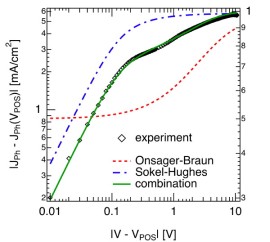
An experimental curve of the photocurrent of a P3HT:PCBM solar cell is shown in the figure (relative to the point of optimum symmetry, as described by [Ooi 2008]. The symbols show our experimental data, the green curve a fit with two of the contributions mentioned above: polaron pair dissociation (after [Braun 1984]) and charge extraction (after [Sokel 1982]). Both models are simplified, but more on that later. Polaron recombination has been covered before (here and here); photocurrent-fit.jpgit is pretty low in state-of-the-art bulk heterojunction solar cells, and has therefore been neglected. For now, lets concentrate on the contribution from polaron pair dissociation. For the sample shown in the figure, the separation yield approaches 60% at short circuit current (at about 0.6V on the rescaled voltage axis, 0V corresponding to the flatband case). The question is, why is it so high in polymer-fullerene solar cells, considering that a charge pair has a binding energy og almost half an electron Volt at 1 nm distance, and that recombination is on the order of nanoseconds [Veldman 2008].

Continue reading “Photocurrent in organic solar cells – Part 1”

5.9% and more

Brief note: 5.9 % power conversion efficiency (german, translation here; [Update 28.11.2009] it now says 6.07%) from small molecule p-i-n tandem solar cell with 2 sqcm area, made by Heliatek in Dresden. Nice picture (also by Heliatek:-)
Small Molecule Solar Cell, Foto by Heliatek GmbH.

The claim “new world record: efficiency of organic solar cell increased to 5.9%” should be preceded by “almost”, or succeeded by “based on small molecules”, because less than 2 months ago, Konarka had a press release about a certified efficiency of 6.4% for an organic bulk heterojunction solar cell. Although not mentioned in the press release, this one is probably not a tandem cell.

[Update 3.9.2009] After talking to Moritz Riede, a researcher from Dresden, I understood that the world record is unique in as far as the area is above one square-centimeter: 2 cm2, whereas the Konarka cell has only 0.76 cm2 – almost at, but not quite above “unity”. This distinction comes from the solar cell efficiency tables by Green et al. (see for instance [Green 2009]).
Thus, the 5.9% are best for small molecule based solar cells, and the best organic solar cells above one cm2: congratulations!

Add to Connotea

Making The Round: New Report on Materials for Organic Photovoltaics Sector

Via David Kirkpatrick’s Blog: Little Friend

Yesterday, a new report on the future prospects of the organic photovoltaics business was presented by the analyst firm Nanomarkets. It is said to include a roadmap for improvements in organic solar cell lifetimes and efficiencies, as well as forecast of volume and price of relevant materials over the course of eight years.

I cannot comment on the analysts’ expertise, although they are specialised on market research for organic and printable electronics – which has pros (they know what they are talking about) and cons (they might be pretty subjective), I reckon;-) See their press release here. All in all, a promising future is just what we need:-)

Add to Connotea

New blog on organic and hybrid photovoltaics

Today I found a new blog Hallburg in November(only a few days old) on hybrid and organic photovoltaics by Juan Bisquert, Professor for Applied Physics in Castelló de la Plana, Spain. I know him as author of interesting papers, a recent one being the review-like article on a rather fundamental view on diffusion and its different interpretations in disordered materials [Bisquert 2008]. Also, allow me the unrelated remark (personal interest, so to say;) that his university seems to be just within a wine region, similar to my home of choice.

As fellow blogger with common interest:

Welcome!

I am looking forward to reading your posts.

Carsten

Update 20.2.2009: At the same time, another new blog from the same university started; same topic, different style.

Add to Connotea

Mobility and Efficiency of Polymer Solar Cells

Joshua TreeDisordered organic materials inhibit charge carrier mobilities which are orders of magnitude lower than for inorganic crystals. First thing missing in disordered matter is the regularly ordered lattice of atoms, where the charge carriers can delocalise, leading to band transport. Second thing is the generally lower interaction between adjacent molecules, which is due to weaker bonding and larger distances. The transfer integral, the value of which goes exponentially down with distance, to get from one to the other molecule is too low for delocalisation. Thus, in terms of charge carrier mobility, think 10-2cm2/Vs for disordered organics (if you are lucky) vs. at least 102cm2/Vs for ordered inorganics.

How much does a weak charge transport limit the performance of organic solar cells? How bad is it?

Continue reading “Mobility and Efficiency of Polymer Solar Cells”

Industry Again…

Plextronics just opened its first manufacturing development line for organic ink (in contrast to the inorganic ink news from last week) to be used in polymer solar cells. Boston SkylineA stage prior to production, this is still good news for the organic photovoltaics community. The spin-off from Carnegie Mellon University, founded in 2002, describes its focus as being

on organic solar cell and organic light emitting diodes (OLED), specifically the conductive inks and process technologies that enable those and other similar applications.

I mentioned Plextronics already last year, as they presented the (up to now, I believe) highest certified power conversion efficiency for an organic solar cell.

Indeed, industry news again… for next time, I promise more fundamentals;-)

Add to Connotea

To be improved: Lifetime of Organic Solar Cells

I just came across this press release from the before-mentioned organic solar cell company Konarka. Boston Evening OneI mention it particularly, as our research group participates in this BMBF project to improve the stability of organic solar cells.

A somewhat older press release (see here and here) by the belgian research institute IMEC shows how they managed to improve the stability of the donor material, a conjugated polymer. The improvement is apparent from electrical characteristics and TEM images.

Not being quite as fancy as efficiency improvements, the lifespan of organic solar cells is probably more important for a ssuccessful commercialisation. As you know now that we are “officially” involved, stay tuned: this topics interests me from a fundamental research perspective.

Add to Connotea