
In disordered organic semiconductors, there is no band transport, as there are no delocalised, just localised charges. Consequently, there is no simple band-band recombination of free carriers, and no Shockley-Read-Hall recombination! Of course, there is still recombination going on, a lot of it;-) 
Here I’ll just quote some definitions concerning different types of recombination, and get back with details later.
For a general classification we take a look at Kwan-Chi Kao’s book “Dielectric Phenomena in Solids“.
Looking for monomolecular recombination, we find
The recombination that involves one free carrier at a time, such as indirect revombination through a recombination center (e.g., an electron captures by a recombination center and then recombined with a hole, each process involving only one carrier), is generally referred to as monomolecular recombination.
In organic semiconductors, a recombination centre can for instance be a trapped hole, localised in a deep state; it can induce a monomolecular recombination with a mobile electron. Even knowing this, it still feels like bimolecular recombination, doesn’t it? ;-)
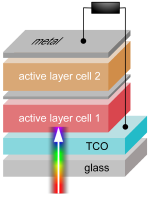
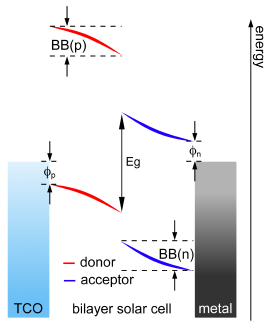


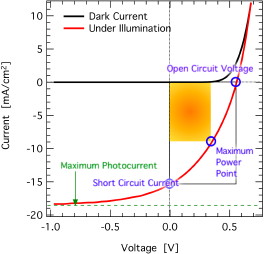 made for crystalline inorganic diodes, when applied on fitting organic solar cells.

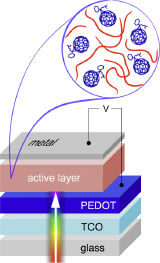 The vision for the so called plastic electronics is to print circuits and devices on flexible substrates. This can be done at room temperature (low energy) and ideally with roll-to-roll processes (high throughput). Sounds good, eh?
