
Photocurrent in organic solar cells – Part 2 [Update]

Almost a year ago, I already discussed the photocurrent in organic bulk heterojunction solar cells. Also, recently I posted about the difficulties to determine the dominant loss mechanism from the short circuit current density dependence on the light intensity. PhotocurrentToday, I would like to extend these statements to the photocurrent in somewhat more general terms.
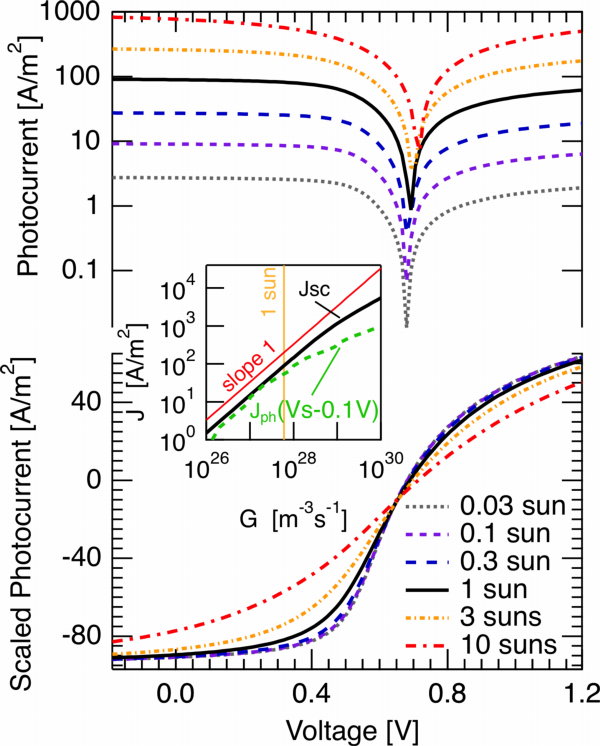
The figure to the right contains the simulated photocurrent for a bulk heterojunction solar cell of 100nm thickness at room temperature. Parameters were chosen according to typical experimentally determined values for P3HT:PCBM solar cells: Bimolecular Langevin recombination with a reduction factor of 0.1 and electron and hole mobility of 10-4m2/Vs were assumed (is it possible I never discussed this reduction really? Seems so, just mentioned it with references here). The top graph shows the photocurrent, in the lower graph the photocurrent was divided by the illumination density in terms of suns (thus, the current densities given on the y-axis are only correct for 1 sun). Consequently, if the photocurrent scales linearly with the light intensity, all curves should coincide. Let me remind you that this was interpreted by different groups (Street et al. among them, but not the first to follow this explanation) as a sign of first order recombination.
Continue reading “Photocurrent in organic solar cells – Part 2 [Update]”

HOPV2010 conference symposium and minor news

Three weeks ago I participated in a very nice Conference on Hybrid-Organic Photovoltaics (HOPV2010) in Assisi, ItalyAssisi. Juan Bisquert, member of the Scientific Commitee, had asked me to organise a discussion panel on Carrier lifetime in bulk heterojunction solar cells. Indeed, a lively exchange of concepts and ideas between the panel – James Durrant, Germa Garcia Belmonte, Gytis Juska and myself – and the audience developed. I would like to thank the organisers, the panelists and the participants of this symposium once again: it was great! I am not sure if I will be able to summarise some of the discussion highlights here, considering that even this note took me 20 days… but I strive to improve;-)

Short note: my short review finally came online. Coauthors are Vladimir Dyakonov and Christoph Brabec. In case you have access to IEEE, find the paper here.

Add to Connotea

Type of Polaron Recombination under Short Circuit Conditions [Update]

Eagle (?) in the EvergladesAs promised, here a glimpse of why I believe that recombination in organic bulk heterojunction solar cells under short circuit conditions (and also at Voc) is not necessarily monomolecular.

Sometimes, the short circuit current density vs light intensity is measured, and from the linear scaling a dominant monomolecular recombination is concluded. In (partial) answer, we have performed some relevant device simulations (thanx to wapf). In short, we varied the generation of free charges over four orders of magnitude, assuming different polaron recombination mechanisms.

Continue reading “Type of Polaron Recombination under Short Circuit Conditions [Update]”

MRS Spring Meeting 2010… already over

Last week, the MRS Spring Meeting took place in San Francisco. It was my first time there, but certainly not the last! ruffled feathersI enjoyed it immensely, despite my extensive last minute preparations of the talk I was invited to give… another first timer for me (on an international conference). In case you are interested, find the slides on scribd. Prof. Venkateswara Bommisetty, one of the organisers of the GG symposium told me that the slides of invited talks will also be made available (if the authors agree).

Many interesting talks, too many to go into more detail in the given time!;-) Anyway, it was nice to meet Alex (glidera) and his colleague Bertrand in person, and spend time with Andy B and Tom!

It was difficult (if not impossible) to agree with Alan Heeger and Robert Street on their propositions that monomolecular recombination is the limiting factor for organic bulk heterojunction solar cells at short circuit current under one sun illumination. Thus, despite both of them being well-known and highly respected, I allow myself to express my strong belief (supported by transient experiments and macroscopic simulations;-) that bimolecular polaron recombination is the dominant loss mechanism for free polarons, instead of monomolecular polaron recombination. Maybe more on this later.

During the conference, and featured in the talk of Karl Leo, Heliatek announced another efficiency record for small molecule solar cells, enhancing their recent achievements to now 7.7% certified efficiency for a tandem cell with 1.1cm2. Again, my congratulations, great stuff!
Continue reading “MRS Spring Meeting 2010… already over”

Be aware of ads…

I finished the Review article I was Schlumpf1recently talking about. If you are interested, the preprint can be accessed here (in a few hours, 20:00 EST according to arXiv, so be patient;-) [Update 2nd March 2010] It’s up:-)

Reviews seem to be pretty subjective, and I am sure there are many omissions, but hopefully not too many inconsistencies. If there are any particular things you do like or do not like, or which are plain wrong: I am happy about every bit of constructive criticism! I submitted the article to Rep. Prog. Phys. It will be peer-reviewed, and I am pretty sure the referees’ comments will make the current version much less final as I’d like it to be;-)

[Update 25.6.2010] The review was accepted after some minor revisions, and is scheduled for publication by Rep. Prog. Phys. in September (2010).

Add to Connotea

Publications – Wind of change?

Via Die Zeit and Nature:
The DFG, Germany’s main funding agency, just put down new guidelines for proposals. Starting in July, the proposals should contain only two directly relevant publications per year of requested funding, as well as up to five other papers (presumably the most important ones) covering the researcher’s general background. Matthias Kleiner, DFG president:

It is quality, not quantity, which matters.

Good point. Nevertheless, although the publish and perish mentality lately became quite tiring, I wonder if (how quickly) these new conditions will change the mentality of the researchers in general, and in particular the ones who are reviewing the proposals and are sitting in the committees for professorship appointment;-)

[Update 25.2.2010] Find the original DFG statement here (pdf, german).

Add to Connotea

Science talking vs doing – and status

There is an interesting post on The Scholarly Kitchen on Talking About Science vs. Doing Science, a critical view on Web 2.0 for Scientists.

Every second spent blogging, chatting on FriendFeed, or leaving comments on a PLoS paper is a second taken away from other activities. Those other activities have direct rewards towards advancement.

Actually, this is one of the reasons for the low activity in recent months: I just do not have time for the blog right now – I believe I can write again end of March or so. Nevertheless, I am active, having written proposals (1 won, 1 open) as well as two review-like papers. One of them is on Organic Bulk Heterojunction Solar Cells, the other on the Role of the Charge Transfer State for Organic Photovoltaics. Writing a third one right now… Once they are published (if they ever are), I will link to them. You are likely to find some figures etc familiar from the blog… and finally something to properly reference :-)

[Update 25th March 2010] 2nd proposal won as well;-) Also, the CT review was accepted by Adv Mater: if you are interested in the preprint, drop me a line.

Add to Connotea

Karl Popper Speaking

From Wikiquote, after reading Scott Berkun. Not funny (as some of these), but thoughful (who’d have expected that? ;-)

Whenever a theory appears to you as the only possible one, take this as a sign that you have neither understood the theory nor the problem which it was intended to solve.

If we are uncritical we shall always find what we want: we shall look for, and find, confirmations, and we shall look away from, and not see, whatever might be dangerous to our pet theories.

Science may be described as the art of systematic over-simplification — the art of discerning what we may with advantage omit.

In his book Making Things Happen, the above-mentioned Scott Berkun summarizes Karl Popper as saying that there are only two kinds of theories: those that are wrong and those that are incomplete.

Add to Connotea

Towards ten percent… Solarmer hits 7.9% with plastic solar cell

Via pv-tech. Brief note on efficiency record: Solarmer has managed to get an (NREL certified) power conversion efficiency of 7.9% for an organic solar cell… sounds good, and broke the recent record (by the same company). It is important to mention, though, that the active area was very small with 0.1cm2 (aperture 0.047cm2).

Add to Connotea