
Via c’t: as  the British Royal Society turns 350, several historical works are available online for the first time. Not only physics, but also medicine etc… In the nice timeline, you find Newton’s theory of light and colour in the year 1672. It links to Phil. Trans. 1 January 1671 vol. 6 no. 69-80 3075-3087. Quite amazing!
Author: deibel
Funding for Organic Photovoltaics Company
Many people believe that organic photovoltaics companies will have to prove soon that  they can come up with commercially viable products within the next two-three years. In this context, Heliatek, a Germany based company developing organic small molecule solar cells with high efficiency, has received 18 Million Euros in a second round of funding from venture capitalists and others. From the press release:
Heliatek will be utilizing the new funding primarily to build an initial production facility in Dresden. In this step and right through to mass production, the company will be using its proprietary tandem technology to efficiently produce, flexible and very lightweight PV modules on a film substrate. Their weight will be merely 500 grams per square meter, instead of today’s customary 20 kilograms per square meter. This will open up a forward-looking market for mobile applications, for architectural solutions and for independently supplying regions with weak infrastructures.
Indeed, interesting times for OPV – particularly in view of the commercial aspects! The science aspects are also getting more and more interesting, but unfortunately I thus have less and less time to write about them here…
P.S. Another company Solexant just starts the production of hybrid solar cells after the process developed by the group of Paul Alivisatos at Berkeley, as reported by Technology Review.
How to publish… not so seriously
Great comical contribution of Jorge Cham’s PhD Comics:  Nature vs Science
The Nature Journal liked it, as apparent from their blog post;-) According to Jorge Cham, their general comment was:
Use this comic for procrastination or decompression, as you see fit.
How to publish… seriously
Less sad than the recent Note on publishing a scientific comment…  As I am in a constant process of trying to understand the requirements for publishing high-impact scientific papers better (slow process… ;-), I am always eager to see what others write about it.
Recently, I linked to some PLOS editorials about Ten simple rules for nearly everything, including writing papers.
Along this line, the presentation given by the Phys. Rev. Lett. Editor Manolis Antonoyiannakis in Japan end of last year, is very interesting. In addition to hints for using the right phrasing when writing about scientific results, he also gives some insight – from the viewpoint of the Editorial Office of a high impact phyics journal – into the inner workings of paper predecision (by Editor) and general acceptance rate. Continue reading “How to publish… seriously”
Influence of Finite Surface Recombination Velocity on Efficiency vs. Mobility of Polymer Solar Cells
Just a quick addition to Mobility and Efficiency of Polymer Solar Cells. You might remember that with increasing mobility, the
open circuit voltage Voc, however, decreases steadily. Actually, the slope steepness is maximum due to our implicit assumption of ideal charge extraction ; for a realistic charge extraction (= finite surface recombination), the Voc slope with mobility is weaker… or even constant for zero surface recombination. The fill factor is maximum at intermediate charge carrier mobilities, not far from the experimentally found values!

As we were finally able to calculate the open circuit voltage with a surface recombination less than infinity (thanks to Alexander Wagenpfahl),
I can show you how it looks. ([Update 3rd March 2010] For details, have a look here: [Wagenpfahl 2010, arxiv]) Continue reading “Influence of Finite Surface Recombination Velocity on Efficiency vs. Mobility of Polymer Solar Cells”
How to Publish a Scientific Comment…
Via the blog Dynamics of Cats: How to publish a scientific comment in 123 Easy Steps by Prof. Rick Trebino. I do not have first hand experience myself, but the described exchange between commentator and editor is very interesting, and indeed very disturbing for an open-minded scientist! See also a comment on Trebino’s essay in the blog Adventures in Ethics and Science.
Photocurrent in organic solar cells – Part 1
In at least two previous posts (Picture Story and How do organic solar cells function – Part 1), I highlighted the field dependence of the photocurrent in organic solar cells, and its connection to the polaron pair dissociation. Actually, there is more to it.
The field dependence of the photocurrent is due to different contributions:
- polaron pair dissociation (bulk heterojunctions and bilayers)
- polaron recombination (mostly bulk heterojunctions)
- charge extraction (bulk heterojunctions and bilayers)
An experimental curve of the photocurrent of a P3HT:PCBM solar cell is shown in the figure (relative to the point of optimum symmetry, as described by [Ooi 2008]. The symbols show our experimental data, the green curve a fit with two of the contributions mentioned above: polaron pair dissociation (after [Braun 1984]) and charge extraction (after [Sokel 1982]). Both models are simplified, but more on that later. Polaron recombination has been covered before (here and here); 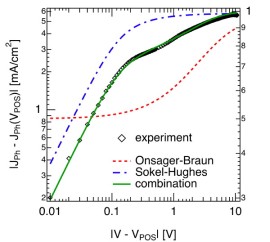 it is pretty low in state-of-the-art bulk heterojunction solar cells, and has therefore been neglected. For now, lets concentrate on the contribution from polaron pair dissociation. For the sample shown in the figure, the separation yield approaches 60% at short circuit current (at about 0.6V on the rescaled voltage axis, 0V corresponding to the flatband case). The question is, why is it so high in polymer-fullerene solar cells, considering that a charge pair has a binding energy og almost half an electron Volt at 1 nm distance, and that recombination is on the order of nanoseconds [Veldman 2008].
Continue reading “Photocurrent in organic solar cells – Part 1”
Personal news: married again…
… and the best news is, it is the same lady;-)
 On the 11th of July 2009, Anja and I celebrated our church wedding. After the civil wedding last December in my home town Wuppertal, we now married in Anja’s home village Schwebheim in Lower Frankonia. It was a wonderful ceremony, and a very nice festivity afterwards (I believe… but I might be biased;-).
The only reason I am already back at my computer is that the beginning of our honey moon is somewhat delayed, as both of us have very interesting but also demanding jobs. Well, postponed is not abandoned!
All the best,
Carsten
5.9% and more
Brief note: 5.9 % power conversion efficiency (german, translation here; [Update 28.11.2009] it now says 6.07%) from small molecule p-i-n tandem solar cell with 2 sqcm area, made by Heliatek in Dresden. Nice picture (also by Heliatek:-)
 .
.
The claim “new world record: efficiency of organic solar cell increased to 5.9%” should be preceded by “almost”, or succeeded by “based on small molecules”, because less than 2 months ago, Konarka had a press release about a certified efficiency of 6.4% for an organic bulk heterojunction solar cell. Although not mentioned in the press release, this one is probably not a tandem cell.
[Update 3.9.2009] After talking to Moritz Riede, a researcher from Dresden, I understood that the world record is unique in as far as the area is above one square-centimeter: 2 cm2, whereas the Konarka cell has only 0.76 cm2 – almost at, but not quite above “unity”. This distinction comes from the solar cell efficiency tables by Green et al. (see for instance [Green 2009]).
Thus, the 5.9% are best for small molecule based solar cells, and the best organic solar cells above one cm2: congratulations!
Ten Simple Rules…
Already a couple of years ago, the editorial of PLoS Computational Biology was about Ten Simple Rules on Getting Published,  which contained useful advice for young scientists. As it was quite successfull in terms of positive response and also the number of downloads, its author Prof. P. E. Bourne wrote advice concerning other non-science but science-related topics for young scientists on PhD and PostDoc level, such as Ten Simple Rules for Getting Grants, Ten Simple Rules for Making Good Oral Presentations, and more. I always liked the idea, and as I recently stumbled across one of these articles, I share the links here. These editorials are open access.
 Notes on Disordered Matter