
Via the blog Dynamics of Cats: How to publish a scientific comment in 123 Easy Steps by Prof. Rick Trebino. I do not have first hand experience myself, but the described exchange between commentator and editor is very interesting, and indeed very disturbing for an open-minded scientist! See also a comment on Trebino’s essay in the blog Adventures in Ethics and Science.
Category: science&culture
Ten Simple Rules…
Already a couple of years ago, the editorial of PLoS Computational Biology was about Ten Simple Rules on Getting Published,  which contained useful advice for young scientists. As it was quite successfull in terms of positive response and also the number of downloads, its author Prof. P. E. Bourne wrote advice concerning other non-science but science-related topics for young scientists on PhD and PostDoc level, such as Ten Simple Rules for Getting Grants, Ten Simple Rules for Making Good Oral Presentations, and more. I always liked the idea, and as I recently stumbled across one of these articles, I share the links here. These editorials are open access.
Science 3.0?
Via Academic Productivity: Interesting comment, What can Science learn from Google? I especially like that it starts with a quote by George Box (you know I like them;-)
All models are wrong, but some are useful.
 The article takes the provocative stance that we do not need models any more to describe the world, as petabyte data clouds combined with massive computing power are able to correlate data.
Data without a model is just noise. But faced with massive data, this approach to science — hypothesize, model, test — is becoming obsolete. […] Correlation supersedes causation, and science can advance even without coherent models, unified theories, or really any mechanistic explanation at all.
I humbly disagree. Understanding needs models, predictions need models. Of course, in order to find models, correlations – probably found by using computers – can show the way.
It is not only content that counts…
rhetoric also counts in publishing papers: see this blog entry by Jose Quesada from Academic Productivity, “Writing style” vs. “content”: Watson & Crick’s example.
Organic Photovoltaics Publications
Today I came across a graph I prepared two years ago: the number of papers published per year in scientific journals within the field of organic photovoltaics. 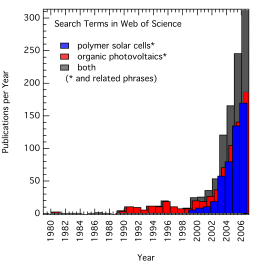 I just updated it using Web Of Science, up to year 2007.
In case you want to reproduce the graph, I used the topic
“organic photovoltaic cell” or “organic photovoltaics” or “organic solar cell*”
for organic photovoltaics and related phrases, and
“bulk heterojunction solar cell*” or “bulk-heterojunction solar cell*” or “polymer photovoltaic” or “polymer fullerene photovoltaic” or “polymer solar cell*” or “polymer fullerene solar cell*” or “polymer-fullerene solar cell*” or “polymer-fullerene solar cell*”
Web of Science can also combine search sets in the history, so that publications matching both sets are not counted twice; the result is shown as the curve “both” in the graph. Probably, by a more appropriate choice of search terms, even some more papers can be found. For instance, I should have included small molecules.
The result is not strictly growing exponentially, but the interest still is increasing continuously. Let’s hope that the commercial interest will have similar growth rates soon;-)
Science Two-O: Openness
M. Mitchell Waldrop from Scientific American wrote an interesting piece on Open Access Science. I found it to be stimulating, even though I am not in yet. Read it here.
 Notes on Disordered Matter